The Future of Digital Smile Design is Artificial Intelligence
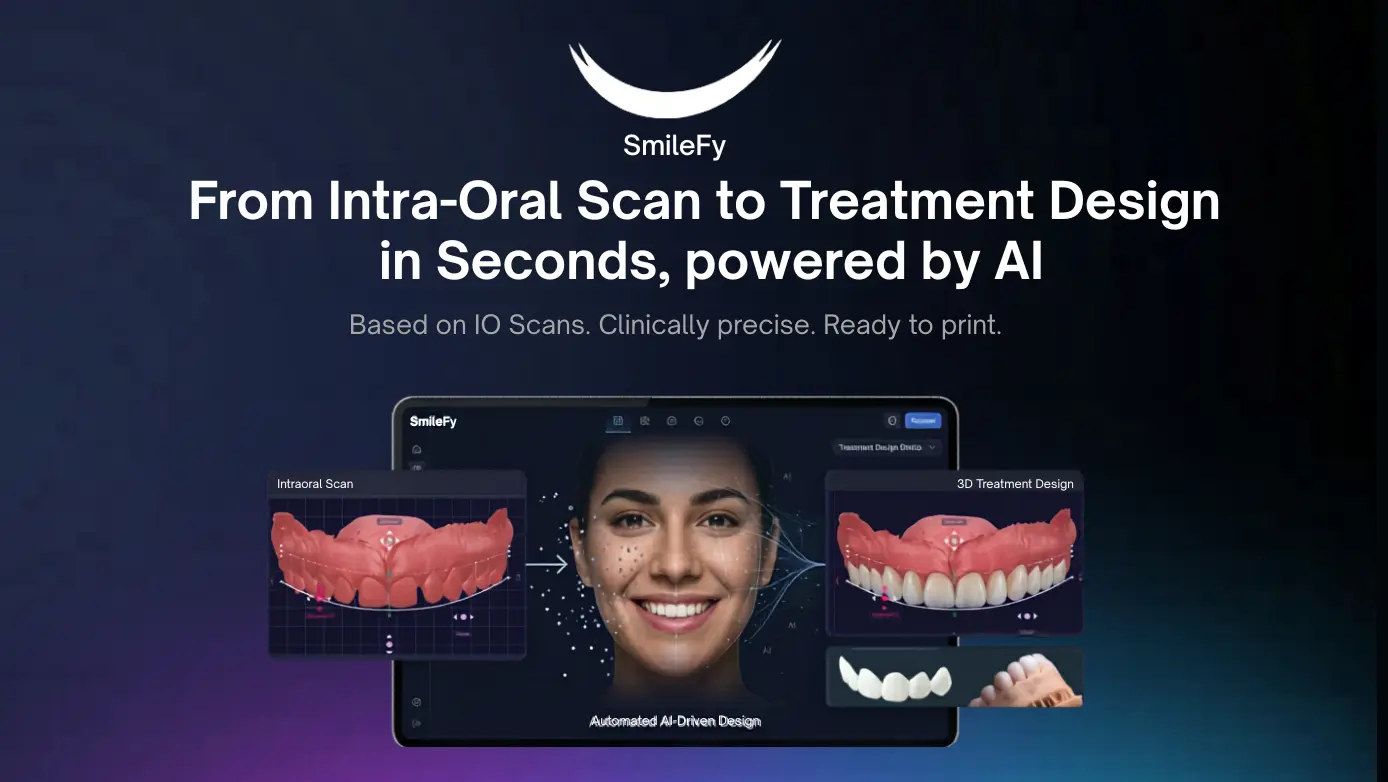
The dental profession is undergoing a once-in-a-generation transformation. Artificial intelligence is no longer a futuristic concept in the operatory — it is today's competitive advantage. This article examines the structural forces reshaping digital dentistry, the pain points that have held the industry back, and how AI-powered platforms like SmileFy are delivering breakthrough solutions that benefit dentists, labs, and patients alike.
1. The Digital Dentistry Market: Scale, Speed & Opportunity
Digital dentistry has moved from the periphery to the mainstream of modern dental practice. Driven by patient demand for faster, more aesthetic, and less invasive treatments — combined with rapid advances in AI, 3D printing, and intraoral scanning — the sector is experiencing one of the most sustained growth cycles in healthcare technology.
$6.1B — Global market size (2024)
~10% — CAGR through 2034
$15B+ — Projected size by 2034
39% — North America market share
Multiple independent research bodies have confirmed the trajectory. The global digital dentistry market was valued at approximately $6.1 billion in 2024 and is forecast to exceed $15 billion by 2034, expanding at a compound annual growth rate of approximately 9.5–12.6% depending on the segment measured. North America leads with a 39% revenue share, underpinned by advanced healthcare infrastructure, high technology adoption, and robust investment in research and development.
The software segment — which includes AI-powered tools, CAD/CAM platforms, and diagnostic applications — is the single largest product category, commanding more than 55% of the overall market. Orthodontics leads among specialty areas with a 37.5% market share, though restorative dentistry and cosmetic procedures are growing rapidly as patient expectations around aesthetics intensify.
Asia-Pacific is emerging as the fastest-growing regional market. Countries like China and India are investing heavily in dental infrastructure, healthcare digitisation, and dental tourism — creating a vast new addressable market for digital solutions providers.
What is Driving the Market Forward?
Several interconnected forces are accelerating digital adoption across dental practices of all sizes:
Rising patient expectations for aesthetic outcomes, faster turnarounds, and transparent treatment visualisation before committing to procedures.
Aging global populations experiencing higher rates of tooth loss, dental caries, and periodontal disease — increasing demand for restorative treatments.
Shrinking hardware costs for intraoral scanners, milling units, and 3D printers, making digital workflows accessible to small and mid-size practices.
AI and machine learning breakthroughs enabling automated analysis, smile simulation, and design generation that previously required specialist expertise and hours of manual work.
Government expansion of dental coverage programs in the United States, Europe, and Asia, broadening patient access and fuelling procedure volumes.
2. The Industry's Persistent Pain Points
Despite the technology revolution underway, a significant portion of dental practices remain stuck in fragmented, inefficient workflows. The gap between what digital dentistry promises and what most clinicians can actually deliver in daily practice is wide — and that gap represents both the sector's greatest challenge and its most compelling commercial opportunity.
Pain Point 1: Complexity and Steep Learning Curves
Traditional digital smile design workflows are demanding. Legacy CAD software packages require significant training investment, technical aptitude, and continuous upskilling as platforms update. For busy practitioners managing full patient schedules, the barrier to entry is simply too high. Many clinicians have invested in digital tools only to find them too time-consuming to integrate into routine practice — reverting instead to manual methods that are slower, less accurate, and less compelling to patients.
Research consistently shows that a major reason digital adoption lags is not cost — it is complexity. Practices report that the learning curve for advanced design software can span months, and staff turnover can reset that investment entirely.
Pain Point 2: The Gap Between Simulation and Clinical Reality
One of the most damaging problems in early digital smile design was the disconnect between what a 2D simulation showed and what the patient actually received. Flat, photo-edited simulations could portray almost any result — but bore little resemblance to the three-dimensional reality of teeth, gums, and facial anatomy. Patients who accepted treatment based on unrealistic previews were frequently disappointed with outcomes that did not match their expectations, eroding trust in both the technology and the clinician.
> A 2024 systematic review published in Cureus found that while Digital Smile Design significantly improves communication, reduces working time, and enhances patient satisfaction, the quality of outcomes is directly tied to the clinical accuracy of the simulation tools used.
Pain Point 3: Fragmented Workflows and Lab Dependency
Most dental practices still operate with fragmented workflows — design is done by one party, printing or milling by another, and fabrication by an external laboratory. This chain introduces delays, communication errors, added cost, and unpredictable quality. Turnaround times of days or weeks are common — a poor experience for patients who increasingly expect speed and convenience.
Pain Point 4: High Cost and Inaccessibility for Independent Practices
Enterprise-grade digital dentistry platforms have historically been designed for large, well-capitalised practices and group operators. For the independent dentist — who represents over 80% of dental practices globally — high software licensing costs, hardware requirements, and the need for dedicated technical staff created a market that was effectively out of reach.
Pain Point 5: Low Treatment Acceptance Rates
Patient communication remains one of the most underappreciated challenges in modern dentistry. Studies indicate that patients consistently struggle to visualise the outcome of aesthetic treatments when presented with verbal descriptions or static clinical photographs. Doubt about irreversible procedures leads to hesitation, deferred decisions, and lower case acceptance rates — directly impacting practice revenue.
A 2024 patient satisfaction study found that nearly 60% of patients feel AI-integrated diagnostic and visualisation tools will improve their overall treatment experience — yet the majority of practices still rely on traditional communication methods that fail to bridge this gap.
3. Artificial Intelligence: The Answer the Industry Has Been Waiting For
Artificial intelligence is not merely an incremental improvement to existing dental workflows — it represents a fundamental redesign of how smile planning is conceived, communicated, and delivered. By automating the analysis of facial proportions, dental anatomy, esthetic principles, and functional parameters, AI eliminates the bottlenecks that have historically made digital dentistry slow, expensive, and inaccessible.
From Hours to Seconds: The Speed Transformation
The first generation of digital smile design required skilled clinicians or specialist technicians to manually map facial geometry, establish reference planes, and iteratively design tooth shapes and positions. A single high-quality 2D smile simulation could take several hours. The shift to AI-driven automation collapses this timeline to seconds — enabling dentists to generate and present realistic smile simulations during the first consultation.
From 2D Images to 3D Clinical Reality
AI enables the transition from flat photo simulations to full three-dimensional design workflows that incorporate intraoral scan data, facial photography, CBCT imaging, and established esthetic principles simultaneously. This means that what a patient sees in their simulation is genuinely representative of what can be delivered clinically — closing the credibility gap that damaged early-generation DSD adoption.
Democratising Advanced Dentistry
Perhaps the most transformative impact of AI in smile design is its potential to democratise access to sophisticated clinical capabilities. When complex esthetic analysis is automated and presented through an intuitive interface, the expertise required to produce outstanding results is dramatically reduced. A general dentist with no specialist training in esthetic analysis can deliver treatment planning quality that previously required years of postgraduate education.
4. SmileFy: AI-Powered Smile Design for Every Practice
SmileFy was founded on a conviction that the most impactful innovation in dental technology would not be more powerful tools for specialists — it would be intelligently designed tools accessible to every clinician. Built at the intersection of AI research, dental science, and human-centred design, SmileFy has grown to serve over 49,000 users worldwide, delivering more than 69,000 smile designs with a reported 98% success rate.
69,541+ — smile designs completed
49,121+ — active users worldwide
98% — reported success rate
90% — satisfied clients
Solving Complexity: Intuitive Design from Day One
SmileFy was architected from the ground up to eliminate the intimidating learning curves that have blocked digital adoption across independent practices. The platform's guided onboarding, step-by-step workflows, live weekly webinars, and structured SmileFy Academy courses ensure that clinicians can complete their first professional-quality 3D smile design quickly — without prior digital design experience.
Closing the Simulation-to-Reality Gap: 3D AI Design
SmileFy's AI goes significantly beyond 2D photo manipulation. The platform integrates AI-driven analysis of facial features, incisal edges, gingival margins, smile dynamics, intraoral scan data, and CBCT segmentation to produce three-dimensional smile designs that are clinically transferable and biologically grounded.
A particularly distinctive innovation is SmileFy's "Smile Clone" capability — rather than applying generic tooth templates, the system uses the patient's own teeth as the design foundation, adjusting only size and position while preserving the individual's natural facial harmony and genetic identity.
> Clinical Feature Spotlight: ONE-CLICK AI Smile Design — Launched in December 2025, SmileFy's ONE-CLICK AI Smile Design allows a dentist to upload a single frontal patient photo, select a treatment type, and receive an instantly generated, AI-driven smile simulation within seconds.
Eliminating Fragmentation: End-to-End Digital Workflows
SmileFy addresses workflow fragmentation by providing an integrated end-to-end solution that spans simulation, 3D design, and in-office fabrication. The platform generates 3D print-ready files for mock-ups, injectable composite guides, veneer shells, temporary restorations, implant bridge designs, and crown temporaries — all from within the same interface.
The following core tools are available within the SmileFy 3D workflow:
Digital Wax-Ups for testing smile prototypes before clinical execution
Mockup Shells and Injectable Composite Guides for precise chairside application
Direct Composite Guides enabling same-session restorations
Gum Contouring Guides for soft tissue management planning
Crown Temps and Implant Bridge Design for full restorative workflows
SmileFy AVA (AI Video Animation) — AI-generated video showing the patient's new smile in motion
Accessibility for Every Practice: Affordable and Scalable
SmileFy's pricing model is built to serve independent practitioners — not just large group practices. The platform operates on a subscription-based membership that includes unlimited 3D AI smile designs, unlimited exports, live training, weekly webinars, and access to the SmileFy Academy.
The platform runs natively on iPad, iPhone, and Mac — devices that most dental professionals already own — removing the requirement for dedicated workstations or specialist IT infrastructure.
Transforming Case Acceptance: Patient Communication Reimagined
SmileFy's most commercially significant contribution to practice economics may be its direct impact on treatment acceptance rates. The ability to generate a photorealistic, AI-driven smile simulation within 60 seconds — during a first consultation — fundamentally changes the emotional dynamic of the treatment planning conversation.
When a patient sees their new smile before a single tooth is touched, the abstract becomes concrete. Doubt is replaced by excitement. The emotional engagement created by an instant, personalised simulation creates the "Yes!" moment that converts consultations into committed treatment plans.
5. The Evidence Base: What the Research Says
The clinical and commercial case for AI-powered digital smile design is increasingly supported by peer-reviewed research. A 2024 systematic review in Cureus concluded that Digital Smile Design consistently improves clinician-patient communication, reduces working time, minimises errors, enhances patient satisfaction, and provides superior clinical accuracy for final prosthetic pieces.
A 2024 study in the Journal of Dental Sciences found that pre-treatment visualisation significantly increases acceptance of proposed treatment plans — particularly for procedures that patients perceive as irreversible or high-stakes.
> Published Evidence Summary — Across ten studies reviewed in a 2024 Cureus systematic review, Digital Smile Design demonstrated consistent benefit across five dimensions: (1) improved clinician-patient communication; (2) reduced working time; (3) minimised procedural errors; (4) enhanced patient satisfaction; and (5) improved clinical accuracy of final restorations.
6. The Road Ahead: AI, Automation, and the Future of Smile Design
The trajectory of AI in dental practice points toward even deeper integration across the clinical workflow. SmileFy's current roadmap includes automated occlusal curve calculation, AI morphology analysis, axial angulation analysis, AI contact and function analysis, and automatic post-operative mock-up design for subtractive preparation visualisation.
The SmileFy Academy — which partners with multiple US universities and builds a global community of digital practitioners — reflects a broader understanding that technology alone does not drive transformation. Education, community, and clinical confidence are equally important.
What This Means for Dental Practices Today
For dental practices considering their digital strategy, the decision is no longer whether to adopt AI-powered smile design — it is when and how. The practices that move earliest will establish a meaningful competitive advantage: the ability to present instant, photorealistic, patient-specific smile simulations at first consultation, offer in-office 3D-printed mock-ups, and deliver fully digital treatment workflows.
For independent practices in particular, SmileFy represents an opportunity to access capabilities that were previously the exclusive domain of large, well-funded dental groups — and to do so at a price point and with an onboarding experience designed specifically for the realities of single-operator and small-group practice.
Conclusion
Digital dentistry is not a future trend — it is the present competitive landscape. The practices thriving today are those that have successfully integrated AI-powered design tools into their daily workflows, using technology not to replace clinical judgment, but to amplify it.
SmileFy has arrived at precisely the right moment. The platform directly addresses the five most persistent pain points holding the industry back — complexity, simulation accuracy, workflow fragmentation, cost, and treatment acceptance — with solutions that are clinically grounded, commercially accessible, and designed with the realities of modern practice in mind.
The market data is unambiguous: digital dentistry is growing at double-digit rates, patient expectations for aesthetic outcomes are rising, and AI is rapidly becoming the standard rather than the exception in smile planning.
— • —
Learn more and start your free trial at www.smilefy.com
Sources & Further Reading
Grand View Research — Global Digital Dentistry Market Size & Trends Report (2030)
Precedence Research — Digital Dentistry Market Size and Forecast 2025–2034
Market.us — Digital Dentistry Market News (July 2025)
Fortune Business Insights — Digital Dentistry Market Size, Share & Trends Report (2032)
Global Growth Insights — Digital Dentistry Devices Market (2025–2033)
Jain A. et al. — "The Recent Use, Patient Satisfaction, and Advancement in Digital Smile Designing: A Systematic Review." Cureus, June 2024
Alharkan HM — "Integrating digital smile design into restorative dentistry: A narrative review." Saudi Dental Journal, April 2024
Buduru S. et al. — "Perceptions in Digital Smile Design: AI-Based Application." Dentistry Journal, April 2024
SmileFy Inc. — ONE-CLICK AI Smile Design Press Release, December 2025
Institute of Digital Dentistry — "How AI is Transforming Cosmetic Dentistry with SmileFy" Podcast, 2025
Adit — "Elevating Patient Engagement in 2024" (survey data on AI in dentistry)
How this post will look when shared
smilefy.com
The Future of Digital Smile Design is Artificial Intelligence
How SmileFy is solving the dental industry's most persistent challenges and reshaping the patient experience…