Patients don’t reject esthetic treatment. They reject uncertainty.
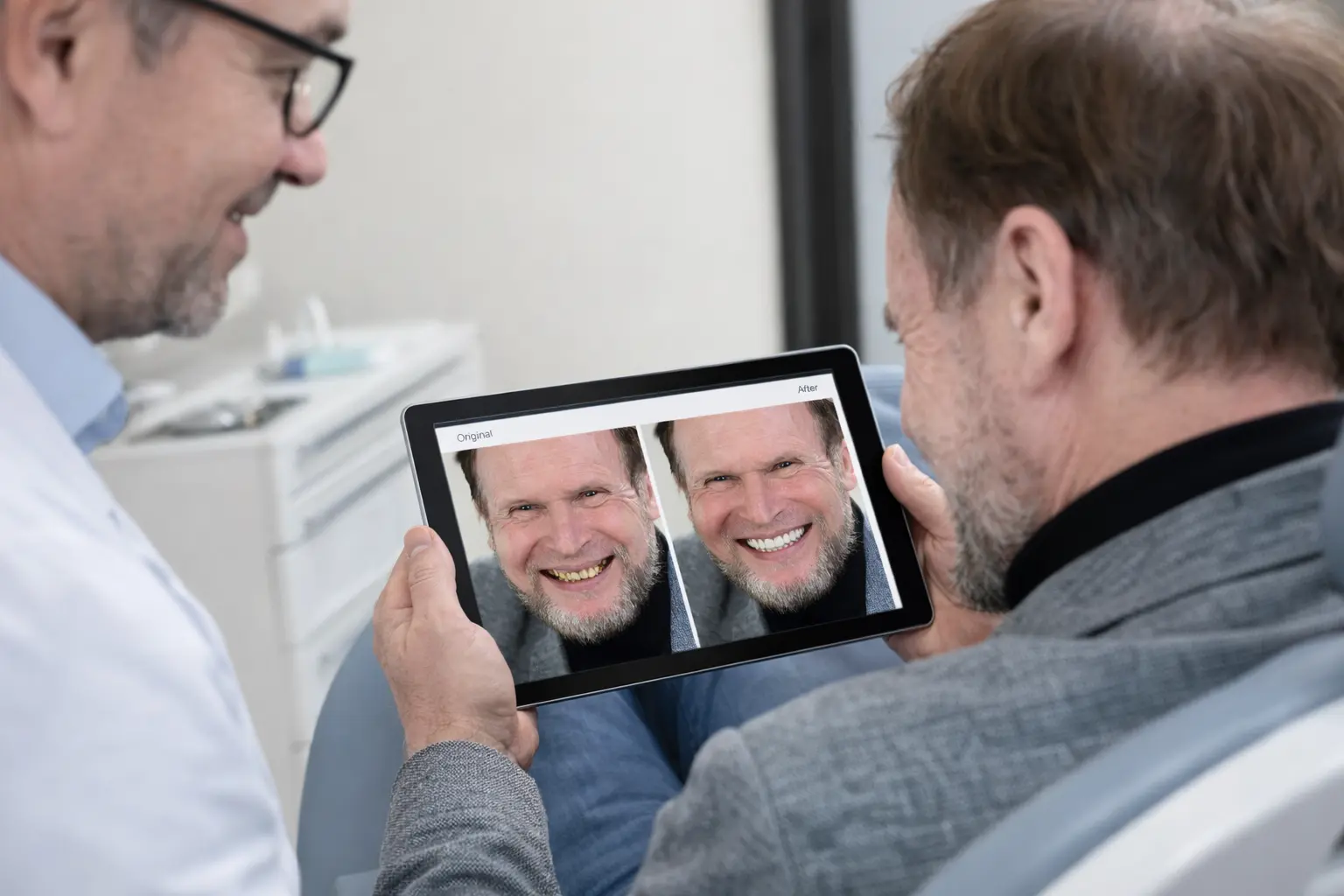
You know the consultation that goes well.
The patient is engaged. They lean forward when you show them the simulation. They ask about timing. They want to know what the recovery looks like. By the time they leave the chair, you're already mentally blocking the case.
Then the weeks pass. Your coordinator calls. The patient is friendly, apologetic, noncommittal. Something came up. They're still thinking about it. They'll circle back.
They don't circle back.
Most practices file this under "cost objection" or "not the right patient." Neither explanation is accurate — and neither one points toward a fix. What actually happened has less to do with the patient's desire and more to do with what happened to it after they walked out of your practice.
Decisions Don't Happen in the Consultation Room
The consultation is where interest forms. It is rarely where decisions are made.
Major elective commitments — and a smile makeover is exactly that — get processed outside the clinical environment. On the drive home. At dinner when a partner asks what the dentist said. Late at night when the estimate is read for the third time. These are the moments when the case is won or lost, and the dentist is present for none of them.
Research published in BMC Oral Health examining patient decision-making across dental treatment types found that psychological and social factors — not clinical ones — are the dominant drivers of whether patients proceed with elective care. The patient sitting across from you is not asking "is this the right clinical intervention?" They are asking something closer to "can I trust that this outcome is real, and am I confident enough in it to write the cheque?"
That question is easiest to answer in the room, with the dentist present, with a visual on the screen. It becomes progressively harder to answer the further the patient gets from that moment.
The problem is not that patients change their minds. It is that the confidence you built during the consultation has nowhere to live once they leave.
The Memory Problem Nobody Talks About
There is a body of research on patient recall of healthcare consultation content that the dental industry has largely ignored — and it is directly relevant to why esthetic cases go cold.
A study published in PLOS ONE tracking patient recall of specialist outpatient appointments found that one week after a consultation, patients could accurately recall only 49% of the decisions and recommendations discussed — without prompting. A separate review in the medical literature found that patients remember between 20% and 60% of information provided by healthcare practitioners immediately after an encounter, with recall dropping to 12.8% a month later.
Read that again in the context of an esthetic consultation. Within one week of the appointment where you showed a patient their proposed smile, explained the treatment sequence, described the restorative parameters and the expected outcome — roughly half of what was discussed has gone. Within a month, nearly all of it.
This is not a failure of patient attention or clinical communication. It is a documented feature of how human memory handles healthcare information, particularly when received in a clinical environment that does not match the home environment where the decision eventually has to be made. As one research team noted, information given under the mild stress of a clinical setting is recalled poorly in the more relaxed context where it needs to be applied.
For a crown or a filling, this matters less. The patient has a symptom reminding them why treatment was recommended. For esthetic treatment, the symptom is entirely visual — and the only version of that visual that existed was on your screen, during the appointment, in a context the patient can no longer fully reconstruct.
What the Industry Numbers Confirm
The memory research explains a pattern the industry has measured but rarely diagnosed correctly.
Dental analytics data shows that the average "closed treatment percentage" across U.S. practices — the share of presented treatment that actually reaches the schedule — sits around 34 cents on every dollar. For every $100,000 in treatment presented, approximately $66,000 never gets booked. A Levin Group survey found that two-thirds of U.S. practices run overall case acceptance rates between 20% and 50%, with esthetic and elective procedures consistently at the lower end.
The standard interpretation is that patients are price-sensitive, that financing options need to improve, that the presentation needs work. These factors are real. But they explain a fraction of the gap. The larger mechanism is simpler and less flattering: by the time most patients are asked to commit, they are working from a partial memory of a conversation that happened weeks ago, with no visual reference to anchor their confidence and no clinical presence to answer the questions that have accumulated in the interim.
The decision window — the period between peak motivation and actual commitment — is where most of this production disappears. And in the traditional esthetic workflow, that window is kept open far longer than it needs to be.
The Lab Turnaround Is Not a Clinical Requirement. It Is a Psychological Liability.
Here is the part of the conversation that most practices have never framed this way.
A patient leaves a compelling consultation. They are told the lab needs two to three weeks to work up the case. They will see a more complete picture at the next appointment. This is presented as a necessary step in a careful clinical process — and clinically, it often is.
But from the patient's psychological perspective, those two to three weeks are not waiting time. They are active erosion time. Every day in that window is a day in which:
The specificity of the consultation fades. The patient's mental image of their proposed smile — which was vivid in the room, tied to your voice and the screen and the energy of the appointment — becomes increasingly abstract. The features that made it feel personal and real start to blur into a general idea of "nicer teeth."
The social layer complicates things. A spouse, a parent, a close friend asks to see the proposal. The patient describes it verbally. The person who is about to share in this financial decision forms their opinion based on a description rather than a visual. The enthusiasm that was infectious in the consultation room cannot be transmitted through a sentence.
Financial hesitation fills the space that clinical confidence vacated. When patients are confident in an outcome, cost is a variable to be managed. When confidence is uncertain, cost becomes a reason to wait. The estimate that seemed reasonable in the room starts to feel more significant when it is no longer attached to a clear picture of what it produces.
By the time the treatment plan is ready and the follow-up appointment arrives, the practice is not continuing a conversation. It is restarting one — from a position of lower patient motivation, higher accumulated doubt, and no new visual information to change the equation. The lab turnaround transformed a warm case into a lukewarm one. Not through any fault of the clinical team. Simply through the passage of time.
Speed Is Not an Efficiency Metric. It Is a Psychological One.
The case for faster treatment design is almost always made in operational terms — reduced chair time, faster workflow, less manual effort from the clinical team. These are genuine benefits. They are not the primary one.
The primary benefit of compressing the time between consultation and treatment design is that it keeps the patient inside their own decision momentum. A personalised smile simulation shown during the consultation — before the patient stands up and reaches for their coat — is worth more to case acceptance than a higher-quality simulation delivered fourteen days later. Not because the visual is better. Because the patient's emotional context for receiving it is still intact.
This is what the patient recall research makes concrete: the clinical conversation is most powerful at the moment it happens. Every day after that, its influence diminishes. A tool that generates a credible visual proposal in the same appointment does not just save the dentist time. It intervenes in the memory decay curve before it begins.
The same logic extends to treatment design. When a scan-based 3D treatment plan is ready within days rather than weeks, the follow-up conversation happens while the patient still has the emotional residue of the consultation. The case is warm. The questions that formed during the waiting period are fewer because the waiting period was shorter. The commitment is asked for at the moment of highest confidence, not after it has been eroded by time and uncertainty.
What Changes When the Workflow Changes
Most esthetic practices are operating on a workflow architecture that was built around lab logistics, not patient psychology. The sequence — consult, wait, follow up, plan, decide — made sense when there was no alternative to the two-to-three week turnaround. That alternative now exists.
The workflow comparison is straightforward when it is laid out explicitly:
The traditional path: Consultation creates peak motivation → patient leaves with a verbal summary and a number → lab turnaround opens a two-to-three week memory decay window → follow-up appointment attempts to rebuild commitment that has partially dissolved → acceptance depends on how much enthusiasm survived the gap
The AI-integrated path: Consultation creates peak motivation → personalised simulation shown before the patient leaves → patient carries a visual anchor through the decision period → scan-based treatment design ready within days → follow-up happens while emotional investment is still high → commitment asked for at the moment it is most likely to be given
The clinical outcome at the end of both paths is identical. The patient's dentition has not changed. The proposed treatment is the same. The only variable is the size of the psychological gap between the moment of peak motivation and the moment of commitment — and in the second path, that gap is compressed to the point where confidence rarely has time to erode.
The Two Moments SmileFy Was Built For
SmileFy maps directly onto the two moments in this workflow where the decision either stays alive or begins to die.
The first is the consultation itself. From standard patient photos, SmileFy generates personalised 2D smile simulations in seconds — built around the patient's actual facial features, not a template overlay. The patient does not leave with a treatment plan printout. They leave with a specific, credible image of their own face showing their proposed result. That image exists in their phone. It can be shown to a spouse. It can be returned to at midnight when the doubts start forming. It keeps the consultation present in a way that a verbal description never can.
The second is the commitment window. From intraoral scan data, SmileFy produces complete 3D treatment designs — preparation parameters, restorative guidance, print-ready STL files for mockups, temporaries, and veneer fabrication — without CAD expertise and without the lag of a traditional lab planning cycle. The clinical plan that validates what the patient saw in the simulation can be ready within the same week. The follow-up appointment happens while the decision is still warm.
That sequence — visual at consultation, clinical design before the memory curve flattens — is the structural answer to the problem the industry has been treating as a training issue, a financing issue, or a patient selection issue. It is none of those. It is a timing issue. And timing is a workflow problem with a workflow solution.
The Question Worth Asking
The practices running esthetic case acceptance above 70% are not running better consultations than everyone else. They are not more persuasive, more experienced, or working with wealthier patients. They are working with shorter decision windows — and their patients are holding something concrete through every day of it.
For two-thirds of dental practices, the current acceptance rate on elective treatment sits below 50%. That number has been treated as a benchmark to aspire beyond rather than a symptom to diagnose. The diagnosis, when it is run properly, points to the same place every time: too much time between peak motivation and commitment, too little for the patient to hold onto during that time, and a workflow built around what the lab needs rather than what the patient's decision psychology requires.
The two-to-three week turnaround existed because there was no faster path. There is now. The question is not whether practices can afford to change the workflow. It is whether they can afford to keep the one that is costing them the production they are already presenting.
SmileFy offers a 7-day free trial — full access, no credit card required. The most direct test: run the simulation and treatment plan at your next esthetic consultation and watch what the patient carries out of the consultation room.
Sources
Decision-making regarding dental treatments — What factors matter from patients' perspective? Systematic review, BMC Oral Health / PMC, 2025
Factors associated with patient recall of key information in ambulatory specialty care visits, PLOS ONE, 2018
Patients' memory for medical information, PMC / NIH
The influence of patients' decisions on treatment planning in restorative dentistry, Dental Update, 2023
Levin Group Practice Survey on case acceptance rates, 2021
Jarvis Analytics: closed treatment percentage data across DSO cohorts
DentistryIQ: Exploring choices in the dental assisting profession: Dental treatment coordinator, 2019
How this post will look when shared
smilefy.com
Patients don’t reject esthetic treatment. They reject uncertainty.
Why most esthetic cases go cold has less to do with cost and more to do with memory decay, lab turnaround, an…