The Face Is Not a Reference for the Treatment Design. It Is the Origin of It.
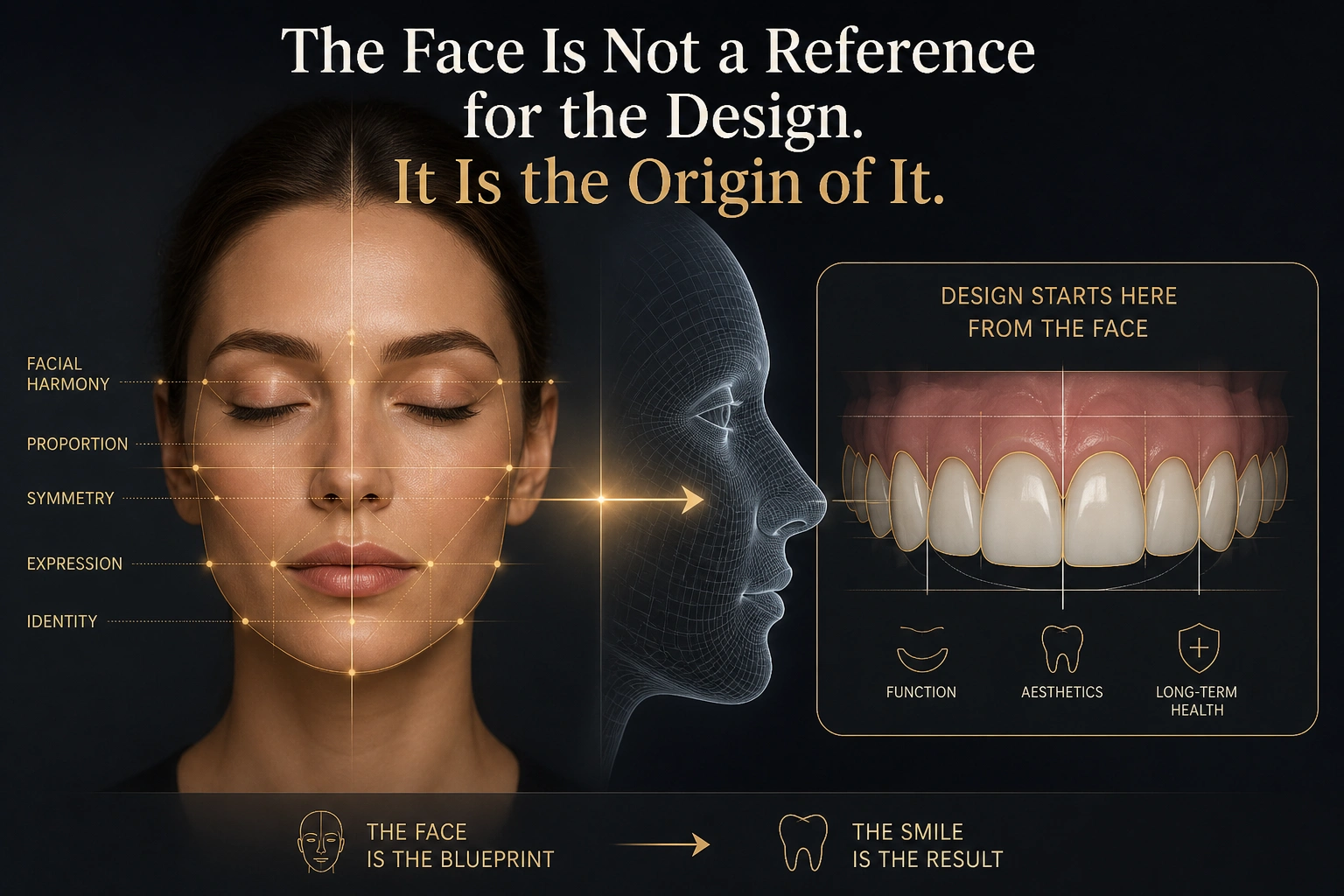
Most digital esthetic workflows begin with the same first step: import the scan, open the design environment, and start working within the tooth geometry. The face enters the process later — as a reference check, a communication tool, a way to show the patient what the design looks like on their actual features.
That sequence is clinically logical. It is also backwards.
The face is not a reference for the design. The face is the origin of it. Where a patient's maxillary incisal edges sit in relation to the upper lip at rest, how much tooth is visible during speech, what the smile arc does relative to the lower lip, how the midline relates to the philtrum — these are the parameters that determine whether a finished restoration reads as natural at the social distance or reads as dental work. None of them live in the scan. All of them exist on the face, before the first instrument touches enamel.
This distinction — face first, scan second — is not a philosophical preference. It is a clinical methodology with a documented history and measurable consequences for treatment outcomes. Understanding it changes how you approach esthetic planning and what you expect digital software to do.
Where Facially Generated Treatment Planning Comes From
Facially Generated Treatment Planning — FGTP — was introduced by Frank Spear in the early 1980s as a framework for complex oral rehabilitation. The core principle, as documented in a 2026 *Dentistry Today* clinical review, is direct: tooth position must be planned first, using the face and lips as the key reference point. Functional, structural, and biological requirements are integrated after the esthetic position is established — not before.
The sequence matters because it determines what controls what. In a scan-first workflow, the existing tooth geometry defines the envelope within which the design operates. The face is consulted at the end. In a face-first workflow, the desired facial parameters define the target tooth position, and the scan data confirms whether the anatomy can support it and maps the clinical path to get there.
These are not two routes to the same destination. They produce different designs — particularly in cases where the existing tooth geometry and the ideal facial esthetic position are not the same, which in esthetic dentistry they frequently are not.
A 2025 *Compendium* case report on full-mouth rehabilitation of severely worn dentition put the methodology precisely: FGTP allows for coordinated orthodontic, periodontal, surgical, and prosthetic interventions so that the restorative team can work toward a unified esthetic goal and improve the predictability of full-mouth rehabilitation. That coordination is only possible when the esthetic goal is established from the face outward — not reconstructed from the teeth inward.
The Parameters That Only the Face Can Give You
Four facial references determine esthetic tooth position in ways that scan data alone cannot resolve. Each one influences the design before a 3D model is opened.
Incisal edge position. Incisal edge position is the most important factor in determining tooth position in smile design — but it is affected by lip dynamics. The maxillary central incisor edges need to be positioned relative to the upper lip at rest, not relative to where they currently sit in the arch. By starting with the repose photo, clinicians give themselves the best chance of getting the maxillary incisal edge position right from the beginning — understanding how lip dynamics, age, and gender all influence incisal display helps create natural, esthetic smiles that fit the individual. A scan tells you where the incisal edges are. The face tells you where they need to be.
The smile arc. The relationship between the curve of the maxillary incisal edges and the curve of the lower lip in full smile is a facial parameter, not a dental one. A design that flattens the smile arc in a patient with a curved lower lip produces a result that reads as unnatural at social distance — not because the teeth are poorly shaped, but because the relationship between teeth and face was designed from within the scan rather than from outside it.
The midline. The facial midline can be curved or perpendicular — and the midline should follow the facial flow. A midline that is geometrically centred in the arch but misaligned with the patient's facial flow will read as off-centre at social distance, even though the scan data supported it. The face, not the arch, defines where the midline belongs.
Upper lip length and mobility. Lip length and mobility affect incisal edge and gingival display. A normal upper lip measures 20–22mm in women and 22–24mm in men. A long upper lip reduces incisal display and changes the target incisal edge position accordingly. This information does not exist in the scan. It exists in the facial photograph — specifically in the repose image, which captures the natural lip position the patient holds throughout their day.
None of these parameters can be reverse-engineered from tooth geometry. They have to be established first. Then the scan confirms the anatomy, identifies the gap between current position and target position, and maps the clinical steps needed to close it.
What Happens When the Sequence Is Reversed
The practical consequence of a scan-first workflow is not always visible. In straightforward cases — young patients, good bone levels, minimal tooth wear, existing positions close to the facial ideal — the design from within the scan and the design from the face outward produce similar results. Experienced clinicians compensate intuitively.
The gap between the two approaches widens significantly in three situations.
Worn dentition. When teeth have lost vertical height through erosion, attrition, or parafunction, the existing incisal edge positions are unreliable references for the final design. The scan faithfully records where the teeth are — which is exactly the wrong starting point. The face records where the incisal edges need to be to restore esthetic display and speech function. A 2025 case report in *Compendium* documented this directly: in a full-mouth rehabilitation of severely worn dentition, the facially generated approach ensured that restorations were guided by esthetic parameters harmonised with function and biology — something a scan-first workflow, working from the compromised existing geometry, could not produce without external facial reference.
Full-arch implant cases. When the natural dentition is absent or non-functional, the scan offers no esthetic reference whatsoever. The tooth positions have to be established entirely from facial parameters — lip support, incisal display, smile width, midline — before any prosthetic design can begin. A 2024 *Journal of Prosthetic Dentistry* clinical report on complete-arch implant rehabilitation confirmed that harmony among the teeth, lips, and facial components is the goal of prosthodontic treatment, whether performed by conventional or digital workflow methods — and that achieving it requires facial data to drive the design, not scan data to constrain it.
Minimally invasive cases. When preparation is minimal or absent, the final restoration has to be right before fabrication begins. There is no preparation depth to compensate for a design that doesn't harmonise with the face. The margin for facial misalignment is smallest exactly when the clinical commitment is most irreversible.
Why AI Makes Facially Guided Planning Accessible for the First Time
FGTP has been established methodology for four decades. It has not been standard practice in most dental offices for a straightforward reason: executing it correctly requires analysing multiple facial photographs, establishing reference planes, overlaying facial data onto scan data, and integrating the resulting parameters into a design environment. Done manually, it is time-intensive enough to be impractical for routine esthetic cases.
Integrating facial and intraoral scans was found to enhance diagnosis and treatment planning by providing essential esthetic and functional parameters — but until AI could perform that integration automatically, the methodology was largely confined to specialists and complex cases.
That constraint is the specific problem SmileFy was built to solve.
SmileFy's AI analyses facial flow, dental proportions, incisal display, and smile arc from patient photographs — establishing the facial parameters that define the target design — and then overlays the intraoral scan onto those facial references to produce a facially calibrated 3D treatment design. The sequence is face first, scan second: the same sequence FGTP has prescribed since the early 1980s, executed in minutes rather than hours, without requiring the clinician to manually perform the facial analysis that has always made the methodology labour-intensive.
SmileFy's AI initiates this process from a single frontal photograph. For cases requiring greater precision, the full facial and intraoral scan integration produces a design where the tooth positions are determined by facial parameters and confirmed by anatomical data — not designed within the scan and checked against the face afterward.
The output is a print-ready STL calibrated to both facial esthetics and actual tooth geometry. The mockup or trial that follows reflects what the face requires, not just what the existing teeth permit.
The Clinical Question Worth Asking
Most digital esthetic workflows are scan-first by default — not because clinicians have decided facial guidance is unnecessary, but because the software that makes facial guidance fast and accessible has not been widely available until recently.
The question is not whether facial parameters matter. Every experienced esthetic clinician knows they do. Key predictors of success in AI-assisted smile design include philtrum height and buccal corridor — both facial parameters established before any restorative design begins. The question is whether the workflow being used establishes those parameters before the design starts — or references them afterward as a final check.
For straightforward anterior cases in patients with existing positions close to the facial ideal, the distinction may be small. For worn dentition, full-arch cases, and minimally invasive restorations where the design has to be right the first time — it is the difference between a restoration designed for the patient's face and a restoration designed for the patient's scan.
Those are not the same object. And at the 1.2 metres of interpersonal distance where your patient will spend every day of their life with the result you delivered, the difference is visible.
---
SmileFy offers a 7-day free trial with full access — no credit card required. The most direct test is to run a current esthetic case through the facially guided workflow and compare the starting design parameters to your existing process.
Sources
*Esthetic and Functional Rehabilitation of Severely Worn Dentition Using Facially Driven Treatment Planning and Digital Workflow*, Compendium of Continuing Education in Dentistry, November 2025
*Interdisciplinary Management of Worn Anterior Teeth: Facially Generated Treatment Planning*, Dentistry Today, January 2026
*Facially generated and cephalometric guided 3D digital design for complete mouth implant rehabilitation: A clinical report*, Journal of Prosthetic Dentistry, 2024
*Revolutionizing dentistry: Exploring the potential of facial scanners for precise treatment planning and enhanced patient outcomes*, Journal of Prosthetic Dentistry, 2024
*Smile Analysis: Diagnosis and Treatment Planning*, ScienceDirect / Dental Clinics of North America, 2022
*Impact of artificial intelligence-based digital smile design on patient and clinician satisfaction and facial esthetic outcomes: A systematic review and meta-analysis*, Sage Journals, 2025
*Digital Smile Design and Patient-Centered Outcomes in Esthetic Restorative Dentistry: A Systematic Review*, PMC / NIH, 2025
How this post will look when shared
smilefy.com
Facially Generated Treatment Planning with AI | SmileFy
Why face-first smile design (FGTP) outperforms scan-first workflows — and how AI makes facially generated tre…