Intra-Oral Scan In. Diagnostic Treatment Design Out. The Restorative Workflow That Removes the Guesswork.
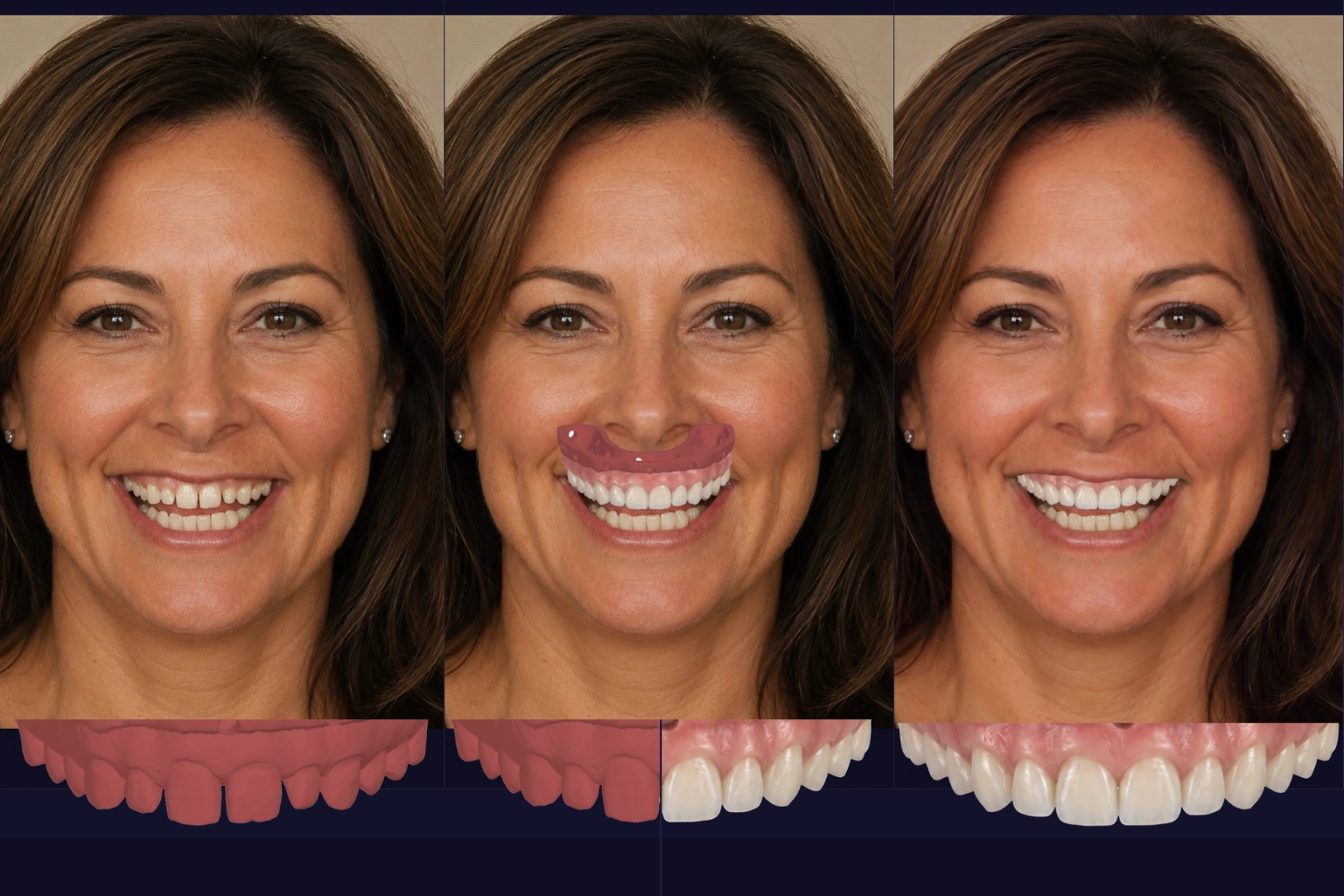
Whether it is a single crown, a few restorations, or a full-mouth rehabilitation, the clinical challenge remains the same: creating a treatment design that balances the patient's biological and functional realities with their esthetic expectations.
In the conventional workflow, the path from here to a delivered restoration runs through several handoffs. The case is scanned. It goes to the lab, or into a CAD environment that requires a trained technician. A design is produced — days or weeks later. It comes back. It is tried in. It is adjusted. Sent back. The patient waits through each step, has to come in several times, and at every handoff, waiting time and cost accumulate for both the clinic and the dental lab.
There is a different workflow. It starts with the same scan and ends with a more predictable restoration — and the design step that used to take days and a specialist now takes minutes and a few clicks.
This is what it looks like.
What "Diagnostic Treatment Design" Means in Restorative Dentistry
A diagnostic treatment design is not a simulation and not a generic template. It is a complete restorative design built from the patient's actual clinical situation — their existing dentition, their occlusal relationships, their restorative requirements — and calibrated to both functional and esthetic parameters.
The word that matters is diagnostic. The design starts from what is clinically present and what the case requires, not from an idealised model of what a perfect dentition looks like. It accounts for the opposing arch, the adjacent teeth, the margin positions dictated by the existing tooth structure, and the occlusal scheme the restoration has to function within.
That is the difference between a design that looks correct and a design that is clinically correct. One is a picture. The other is a plan that can be fabricated and delivered with the restoration fitting, functioning, and lasting.
Step 1: Intra-Oral Scan In
The process begins with two key records: a high-quality intraoral scan and a full-smile facial photograph of the patient.
The intraoral scan captures the complete three-dimensional clinical reality — tooth anatomy, preparation margins, occlusion, arch relationships, and the spatial position of every structure that the final restoration must respect. It is a highly accurate digital record that eliminates the distortions associated with conventional impressions and stone models.
The full-smile photograph provides the facial context. It reveals how the teeth relate to the lips, the smile line, the facial midline, and overall facial proportions. While the scan captures the biology and function, the photograph captures the facial framework for an esthetically pleasing outcome.
Step 2: Diagnostic Treatment Design Out
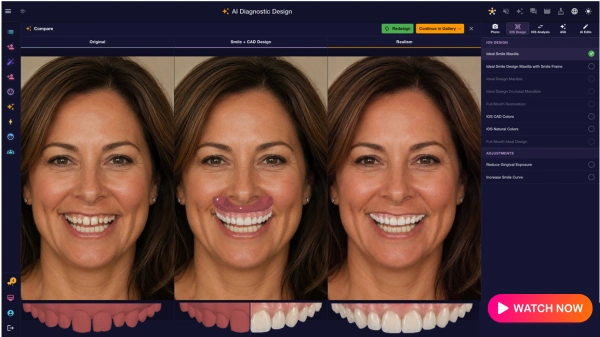
Once the intraoral scan and full-smile photograph are uploaded and calibrated, SmileFy's AI Designer generates a complete diagnostic treatment design based on the patient's actual scan data and instantly integrates it into the patient's facial photograph for validation.
This is not a rough proposal that requires rebuilding. It is a clinically grounded treatment design that respects the patient's existing anatomy, restorative requirements, and facial characteristics. Tooth morphology is calibrated to the patient's clinical situation, while gingival contours, proportions, and smile characteristics are aligned with the facial framework and treatment objectives.
Because the design is generated directly from the dimensional data contained within the intraoral scan, it exists within the same clinical space as the final restoration that will eventually be fabricated. The result is a diagnostic design that is not only esthetically pleasing, but also clinically relevant, functionally informed, and ready to serve as the foundation for treatment planning, patient communication, and laboratory collaboration.
The accuracy of this output has been independently measured. A prospective comparative study published in the *Journal of Esthetic and Restorative Dentistry* in December 2025 compared SmileFy directly against exocad version 3.2 across ten rehabilitation cases, with STL superimposition using Geomagic software and evaluation by twenty blinded prosthodontists. SmileFy showed an average dimensional error of 0.29 ± 0.095 mm against expert CAD design, with no statistically significant differences in primary or tertiary anatomy and no significant difference in clinician or patient satisfaction. The AI-generated diagnostic design is clinically equivalent to specialist CAD output in the parameters that determine fit and function.
Step 3: Adjust to Your Treatment Goals
The AI produces the diagnostic design. The clinician directs it.
This is the step that matters most for any dentist who is cautious about AI in clinical workflows — and it is the step where clinical control is fully retained. Clinicians can adjust the design according to the treatment goal and the specific esthetic requirements of the case with a click.
The AI handles the technical drag — generating a dimensionally accurate design from the scan in seconds rather than the clinician building it manually over an hour. The clinical judgment remains with the dentist. The design conforms to the treatment goals, not the other way around.
This is the correct relationship between AI and clinical decision-making in restorative dentistry. The software removes the time and complexity. The clinician sets the direction and verifies the result against the clinical plan.
Step 4: Present to the Patient — Educate and Inform
A restorative patient does not need to be persuaded. They need to understand and trust.
Restorative treatment involves significant cost and almost always raises questions the patient cannot fully articulate — what is being done, why it is necessary, what the result will be, and whether it will look and feel natural. The diagnostic treatment design, presented across multiple clinical views, is one of the most effective patient-education, informed-consent, and case-acceptance tools available.
This is where a diagnostic treatment design differs fundamentally from a smile simulation. A simulation is purely picture-based — it shows the patient an outcome that cannot necessarily be delivered, because it carries no clinical or dimensional data. A diagnostic treatment design is built from the intraoral scan and the patient's real clinical situation, which means the lab can transform it directly into a restoration design for manufacturing. What the patient sees is what can actually be built.
With the diagnostic design, patients can see what will be restored, how it will relate to their existing teeth, and what the esthetic outcome will be.
This improves comprehension in a way that verbal explanation and written treatment plans cannot. A 2024 systematic review published in the *Journal of Medical Internet Research*, covering 15 randomised controlled trials across 2,454 patients, found that 73% of studies reported statistically significant improvements in health information recall when animated visualisation was used compared with usual care. Patients who see a clear visual representation of their treatment understand it better, retain it longer, and make more informed decisions. For restorative dentistry, where informed consent is both an ethical and a clinical requirement, that improvement in comprehension is a direct benefit to the patient and the practice.
Step 5: Accept
What the patient accepts is a treatment they understand.
Because the diagnostic design was built from the patient's actual clinical situation and refined to the treatment plan, the agreement the patient gives is informed and specific. They are not approving a vague promise of an improved result. They are approving a concrete restorative plan they have seen, understood, and discussed. The acceptance is documented, clear, and grounded in a design that reflects what will actually be delivered.
This is informed consent functioning as it should — the patient understands the proposed treatment, the expected outcome, and the relationship between them, before any irreversible clinical step is taken.
Step 6: Share With Your Lab — In One Click
The diagnostic design that was refined and approved is shared with the lab as complete, lab-ready case documentation and files.
The technician can use it immediately as a blueprint and begin the restoration design in any CAD/CAM software to proceed with fabrication. There is no guessing. No interpretation of a photograph and a set of written notes. No reconstruction of clinical intent from an incomplete brief. The design the clinician refined and the patient approved is the exact design the lab receives — a precise, dimensionally accurate restorative brief.
The technician's expertise remains fully engaged. They refine surface detail, finalise material selection, and prepare the file for manufacturing — following the diagnostic design as the clinical reference rather than reconstructing it. The lab handles everything downstream of the design, exactly as it always has, but from a starting point that carries the complete clinical picture rather than fragments of it.
No 3D printer required in the practice. No additional hardware. No new workflow for the team to manage. The design is created chairside; the lab manufactures from it.
Step 7: Deliver With Higher Predictability and Accuracy
This is where the workflow pays off — at delivery.
When the design, the patient's approval, and the lab's fabrication all share the same accurate clinical dataset, the restoration that arrives fits the case it was designed for. The try-in confirms the design rather than correcting it. Back-and-forth adjustments decrease because the treatment objective and the expected esthetic outcome were clear from the start.
This allows:
Faster delivery. The design step that previously took days through a lab planning cycle or required a trained CAD operator now takes minutes at the chairside. Clinical data reported in 2025 found that AI-assisted design tools reduce case time by 30 to 45 minutes per case.
Lower costs and fewer remakes. When the lab fabricates from an accurate diagnostic design rather than an interpreted brief, the restoration is more likely to fit on the first delivery. The same 2025 clinical data found AI-assisted design tools reduce remake rates by approximately 18%. Fewer remakes mean lower laboratory costs, fewer additional appointments, and less chair time absorbed by corrections.
Higher patient satisfaction. Because the diagnostic design made the expected outcome clear from the start — the patient saw, understood, and approved what would be delivered — the result matches the expectation. The restoration the patient receives is the one they agreed to. There is no gap between what was promised and what was delivered, because the design that was approved is the design that was fabricated.
A 2024 randomised controlled trial found that 92% of patients treated through a full digital scan-based workflow achieved excellent restoration fit, occlusion, and esthetics, compared to 78% in the conventional workflow group. That difference is the practical result of a workflow where the design, the approval, and the fabrication never lost alignment with the patient's actual clinical situation.
The Workflow, Start to Finish
Intraoral scan in. Diagnostic treatment design out, in a few clicks. Adjust to the treatment goals. Present to the patient to educate and inform. Accept an understood, documented plan. Share with the lab in one click to begin manufacturing. Deliver a restoration that fits — and matches what the patient was shown.
Each step removes a margin of interpretation that the conventional workflow leaves open. The result is restorative dentistry that is faster to plan, more predictable to deliver, less costly in remakes and corrections, and clearer for the patient from the first appointment to the final delivery.
SmileFy is the platform built around this workflow. Intraoral scan in, diagnostic treatment design out, lab-ready file shared with a click — at a clinical accuracy independently measured against expert CAD design, without requiring CAD expertise or a separate planning system. It works on any device and with any intraoral scanner.
SmileFy offers 7-day full access — no credit card required. Run a current restorative case through the workflow: scan in, generate the diagnostic design, refine it to your treatment plan, and compare what you send the lab to what you would have sent before.
One case. One week. The difference is visible at delivery.
Sources
*Artificial Intelligence Versus Conventional Methods in Digital Smile Designing: SmileFy vs. exocad* — 0.29 mm average error, no significant difference in primary/tertiary anatomy or clinician/patient satisfaction. Journal of Esthetic and Restorative Dentistry / Wiley, December 2025.
*The Effectiveness of Video Animations as a Tool to Improve Health Information Recall for Patients: Systematic Review* — 73% of 15 RCTs showed statistically significant recall improvements with animation vs. usual care. Journal of Medical Internet Research / PMC, December 2024.
*Digital smile design outcomes* — 92% vs 78% restoration fit, occlusion, and esthetic excellence, scan-based vs conventional workflow. Journal of Pharmacy and Bioallied Sciences, 2024.
*AI and Digital Dentistry in 2026* — Clinical time savings 30–45 minutes per case, remake reduction approximately 18% with AI-assisted design tools. 2025 clinical data.
*Artificial Intelligence in Dental Treatment Planning and Diagnostic Decision-Making: A Systematic Review and Meta-Analysis*. Clinical and Experimental Dental Research / Wiley, 2026.
How this post will look when shared
smilefy.com
Intra-Oral Scan In. Diagnostic Treatment Design Out. The Restorative Workflow That Remo…
From intraoral scan to a lab-ready diagnostic treatment design in minutes — a clinically grounded restorative…