The Thirty Seconds That Determine How Every Esthetic Case Goes
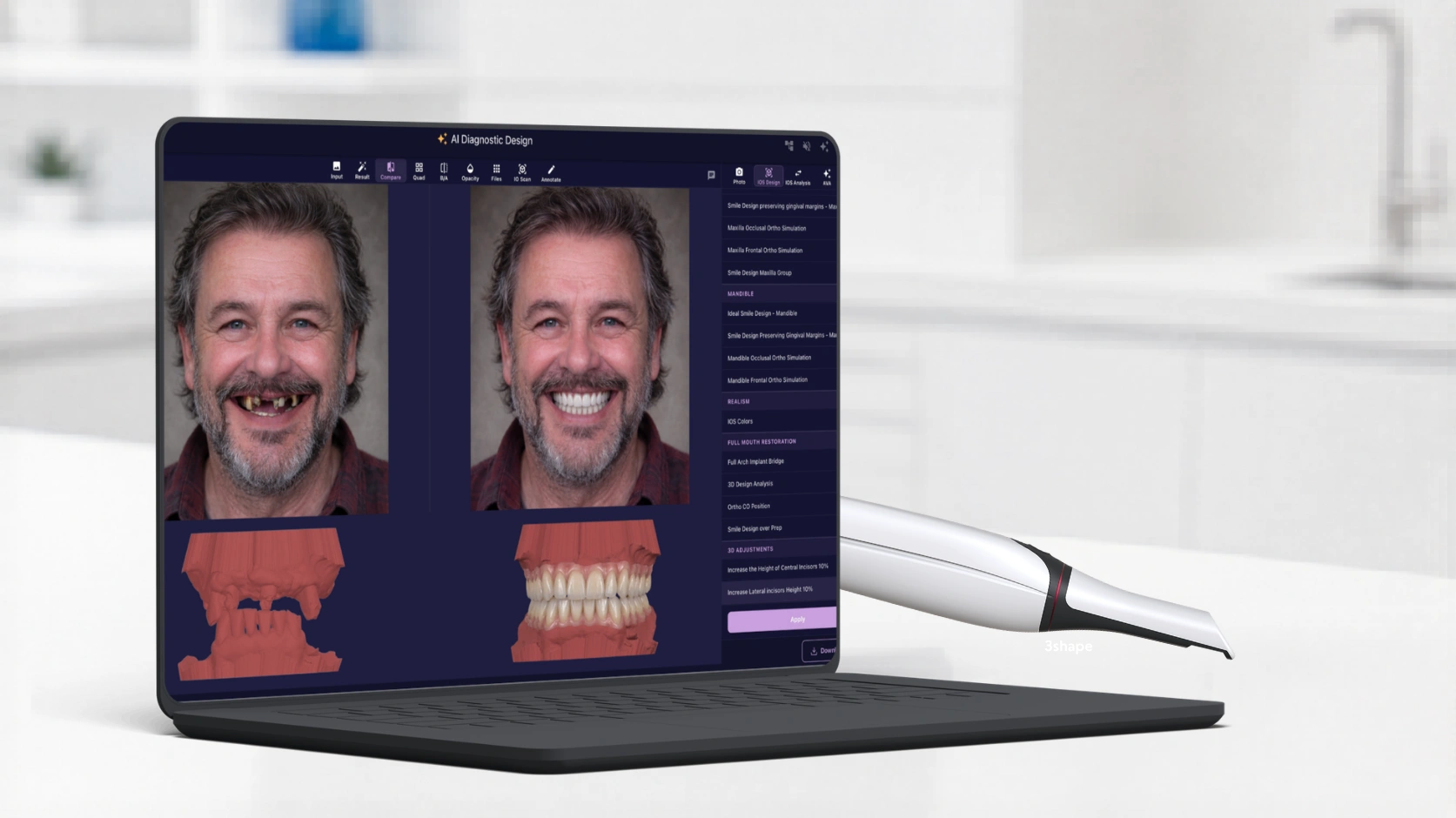
There is a moment in every esthetic case that determines how the rest of it goes.
It is not the preparation appointment. It is not the delivery. It is the thirty seconds after the patient approves the proposed design — when the consultation has done its job and the clinical workflow has to take over. What happens in those thirty seconds, and in the days that follow, determines whether the restoration the patient receives is the one they said yes to, or an interpretation of it.
For most practices, that thirty-second handoff produces a lab brief consisting of an IO scan, a simulation screenshot, and a few clinical notes. The technician opens the file and starts from scratch. The interpretation gap opens. The try-in corrects what the design never grounded.
AI treatment design from an IO scan changes what happens in those thirty seconds — and everything downstream from them.
What AI Treatment Design From an IO Scan Actually Is
It is not a simulation. A simulation is a photograph with modified pixels — it records how a proposed result might look, not the dimensional data required to fabricate it. Most of the tools currently marketed as AI smile design produce simulations. They serve a communication purpose. They cannot drive a restoration.
It is not traditional CAD. CAD systems like exocad and 3Shape are powerful, precise, and built for trained specialists. They require weeks to months of learning before producing reliable output, and they carry the infrastructure costs that reflect that specialisation. They are not built for clinical accessibility.
AI treatment design from an IO scan is a third category — and it is the one that most practices have been missing between the consultation and the lab.
It takes the dimensional data from an intraoral scan — actual tooth geometry, preparation margins, occlusal relationships, gingival contours — and uses AI to generate a complete, three-dimensional treatment design calibrated to the patient's facial parameters. The output is a clinically grounded design that can be presented to the patient at the same appointment, approved at the chair, and shared with the lab as a precise dimensional brief. No CAD expertise. No separate planning software. No waiting period for the design itself.
A 2026 systematic review and meta-analysis published in *Clinical and Experimental Dental Research* — synthesising evidence across multiple dental specialties from database inception to December 2025 — confirmed that AI integration into treatment planning delivers measurable improvements in diagnostic accuracy and clinical decision-making. A separate scoping review published in PMC covering AI applications in fixed prosthodontics found that AI models for crown design and full-arch framework optimisation demonstrated clinically applicable accuracy across multiple independent studies. Clinical data reported in 2025 found that AI-assisted design tools reduce case time by 30–45 minutes per case and lower remake rates by approximately 18%.
The technology is not emerging. It is documented, validated, and available now.
How It Works in the Clinic — Five Steps
Understanding what AI treatment design does in practice is clearest when it is mapped against an actual clinical sequence. Here is what the workflow looks like from first patient contact to lab delivery.
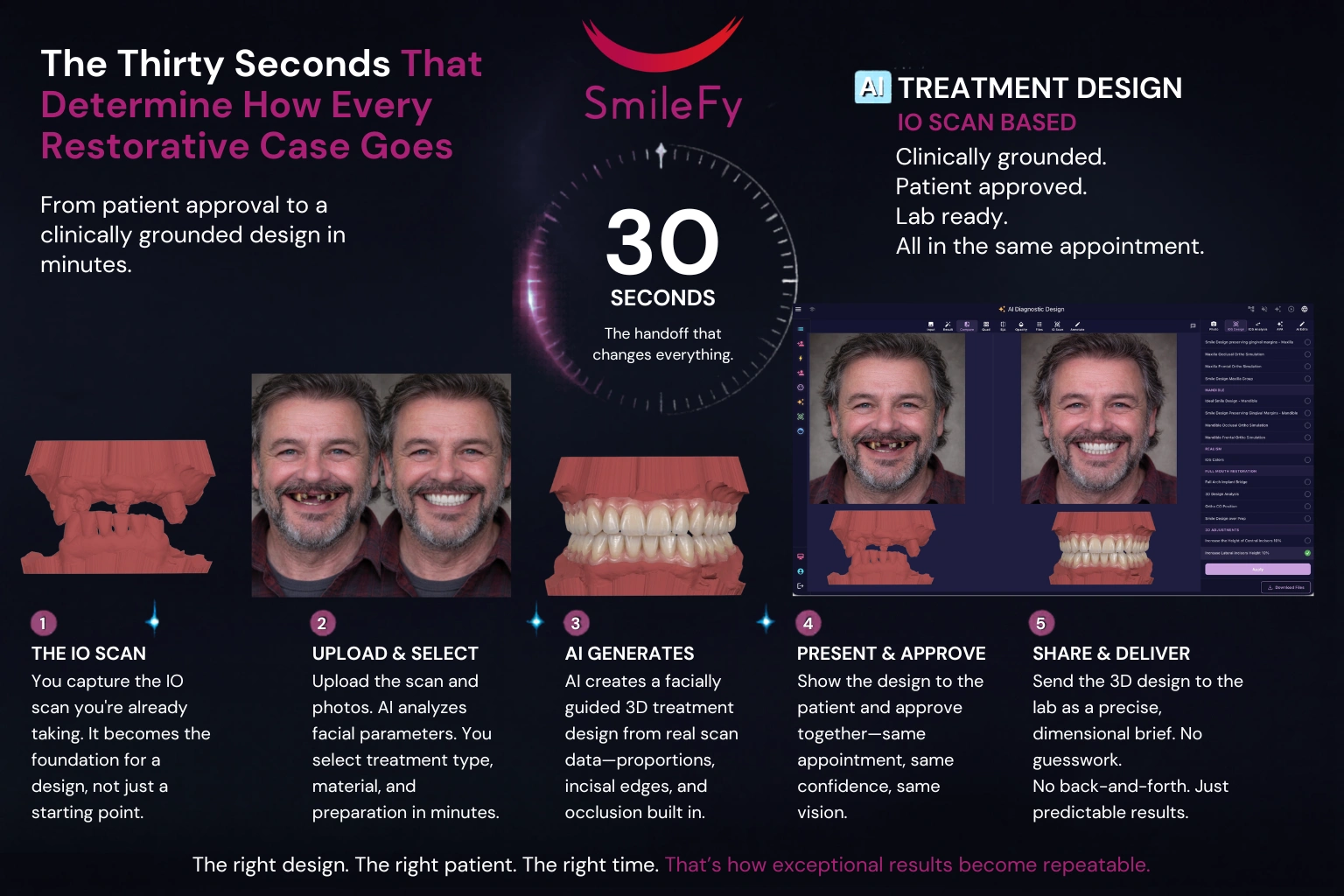
Step 1: The scan — which you are already taking. The intraoral scan captured at the esthetic consultation is the clinical foundation of the entire workflow. Nothing additional needs to be collected. The scan that would previously have gone to the lab as a starting point for interpretation now becomes the input for a design that the lab receives as a finished brief. The scan captures tooth positions, preparation margins, occlusal relationships, and gingival architecture in a format that is directly usable for treatment design — not a photographic estimate of it.
Step 2: Upload and select treatment parameters. The scan is uploaded to SmileFy alongside the patient's consultation photographs. The AI analyses facial parameters — midline, smile arc, incisal display, lip dynamics — and aligns them with the dimensional data from the scan. The clinician selects the treatment type and parameters: number of units, restorative material indication, preparation design. This step takes minutes, not hours. No manual design work. No CAD environment to navigate.
Step 3: The AI generates the treatment design. SmileFy's AI produces a complete, facially guided 3D treatment design built from the patient's actual scan data and calibrated to their facial esthetics. The design includes incisal edge positions relative to the lip, tooth proportions aligned with facial flow, preparation parameters based on actual enamel geometry, and restorative dimensions derived from the real occlusal dataset. This is the design the lab needs — not a simulation the lab has to reinterpret.
A prospective comparative study published in the *Journal of Esthetic and Restorative Dentistry* in December 2025 compared SmileFy directly against exocad version 3.2 across ten esthetic rehabilitation cases, with STL superimposition using Geomagic software and evaluation by twenty blinded prosthodontists. SmileFy showed an average dimensional error of 0.29 ± 0.095 mm against expert CAD design, with no statistically significant differences in primary or tertiary anatomy and no significant difference in dentist or patient satisfaction. The AI-generated design is clinically equivalent to specialist CAD output in the parameters that govern fit, function, and patient outcomes.
Step 4: Present to the patient and approve together. The treatment design is shown to the patient at the same appointment — not at a follow-up visit two weeks later, after the emotional momentum from the consultation has had time to erode. The patient sees a design built from their actual tooth geometry and aligned with their facial features. What they are approving is dimensionally accurate and clinically deliverable. There is no gap between the design they say yes to and the restoration that will be fabricated from it.
This matters clinically and commercially. Research on patient decision-making in esthetic dentistry consistently shows that patients who leave the consultation with a specific, credible representation of their proposed outcome are significantly more likely to proceed than those asked to hold a verbal description through a two-to-three-week waiting period. The design approval happens at the moment of peak patient motivation — before certainty has time to soften.
Step 5: Share the design with your lab — they take it from there. The final output is a lab-ready STL file — a complete, dimensionally accurate treatment design that your dental technician can open directly in their CAD software and use as the foundation for fabrication. No rebuilding from scratch. No interpretation of a photograph or a set of written notes. The design that was reviewed and approved at the chair is the same design the lab receives.
The technician's role shifts from reconstructing clinical intent to executing against a clinical dataset. They complete the CAD workflow on their end — refining surface detail, selecting materials, preparing the file for manufacture — following the exact treatment design produced from the patient's scan. The fabrication reflects the design because the design was accurate to begin with.
No 3D printer required in the clinic. No additional hardware investment. No new workflow for the team to manage. The lab handles everything downstream of the design — exactly as they always have, but from a starting point that eliminates the dimensional gap that previously made try-in corrections routine.
What This Changes for the Practice
Three things shift in a practice that moves to AI treatment design from IO scan data — and each one is measurable.
Case acceptance improves. When a patient approves a scan-based design at the consultation rather than a simulation at a follow-up appointment, the decision happens at the moment of highest motivation. The design is specific to their anatomy, credible as a clinical document, and approved before the decision window has time to narrow. Practices running scan-based design workflows consistently report stronger same-appointment acceptance rates on esthetic cases than practices relying on photo simulation followed by a separate planning cycle.
Remake rates decrease. Clinical data from 2025 shows AI-assisted design tools reduce remake rates by approximately 18% compared to conventional workflows. When the design and the restoration share the same dimensional dataset, the fit is better because the data was never lost in interpretation. The try-in confirms what the design produced. It does not correct what approximation introduced.
The lab relationship changes. A lab that receives a complete 3D design brief rather than an IO scan and a screenshot works from precise input. The technician is executing against dimensional data rather than reconstructing clinical intent from a photograph. The fabrication is more accurate, the communication is clearer, and the case runs with fewer back-and-forth cycles.
Why Starting Now — Not Later — Is the Clinical Decision
Sixty percent of dental practices in the U.S. and Northern Europe now have an intraoral scanner. The clinical data supporting AI-assisted treatment design has crossed from emerging evidence into systematic review and meta-analysis. The technology to connect scan data to a clinically accurate design — without a CAD specialist, without a separate planning system, without a waiting period — is available and validated.
The practices that adopt this workflow in 2026 are not early adopters taking a risk. They are the first wave of standard adoption in a shift that the clinical literature is already treating as mainstream. A 2026 systematic review and meta-analysis in *Clinical and Experimental Dental Research* synthesised evidence on AI in dental diagnostic decision-making and treatment planning across all dental specialties — confirming that AI represents a fundamental shift in how clinical decisions are made and executed.
The argument for waiting is not a clinical one. It is a habit one. The scanner is already there. The scan is already being taken. The design step — which previously required a CAD specialist or a lab planning cycle — now takes a few clicks and produces a clinically validated output.
Every esthetic case presented without a scan-based treatment design is a case where the thirty seconds after approval produce an interpretation gap that somewhere — at the lab, at the try-in, in the patient's comparison between what was shown and what was delivered — will need to be closed.
That gap is not inevitable. It is a workflow choice.
SmileFy AI Treatment Design — The Workflow in Practice
SmileFy is the platform built specifically around this workflow. Photograph and IO scan as inputs. AI-generated, facially guided 3D treatment design as output. Print-ready STL for in-office printing or lab delivery. No CAD expertise required at any step.
The entry point is straightforward: a 7-day free trial with full access. The most useful test is not a demo — it is an actual case. Upload the scan from your next esthetic consultation, generate the treatment design, present it to the patient before they leave the chair, and share it with your lab as a complete brief.
Compare what the lab receives with what they would have received before. The difference is visible at the try-in.
One case. One week.
Sources
*Artificial Intelligence in Dental Treatment Planning and Diagnostic Decision-Making: A Systematic Review and Meta-Analysis*, Clinical and Experimental Dental Research / Wiley, 2026
*Can Artificial Intelligence Optimize Treatment Planning and Outcome Prediction in Fixed Tooth- and Implant-Supported Prosthodontics? A Scoping Review*, PMC, 2025
*AI and Digital Dentistry in 2026: Clinical time savings 30–45 minutes per case, remake reduction approximately 18% with AI-assisted design tools*, Gold Coast Dental / Migliorati et al., 2025
*Artificial Intelligence Versus Conventional Methods in Digital Smile Designing: SmileFy vs. exocad, 0.29mm average error, no significant difference in primary/tertiary anatomy or patient satisfaction*, Journal of Esthetic and Restorative Dentistry / Wiley, December 2025
*From Simulation to Restoration: Bridging the Gap in Digital Smile Workflows*, Frontiers in Oral Health, 2025
*Accuracy of Temporary Laminate Restorations With Digital Workflows: 2D vs. 3D dimensional accuracy in printed provisionals*, ClinicalTrials.gov / NCT07213453
3Shape Digital Dentistry Trends Report, 2026 — IOS penetration data
How this post will look when shared
smilefy.com
The 30 Seconds That Determine Every Esthetic Case | SmileFy
Why scan-based AI treatment design closes the gap between what the patient approves and what the lab receives…